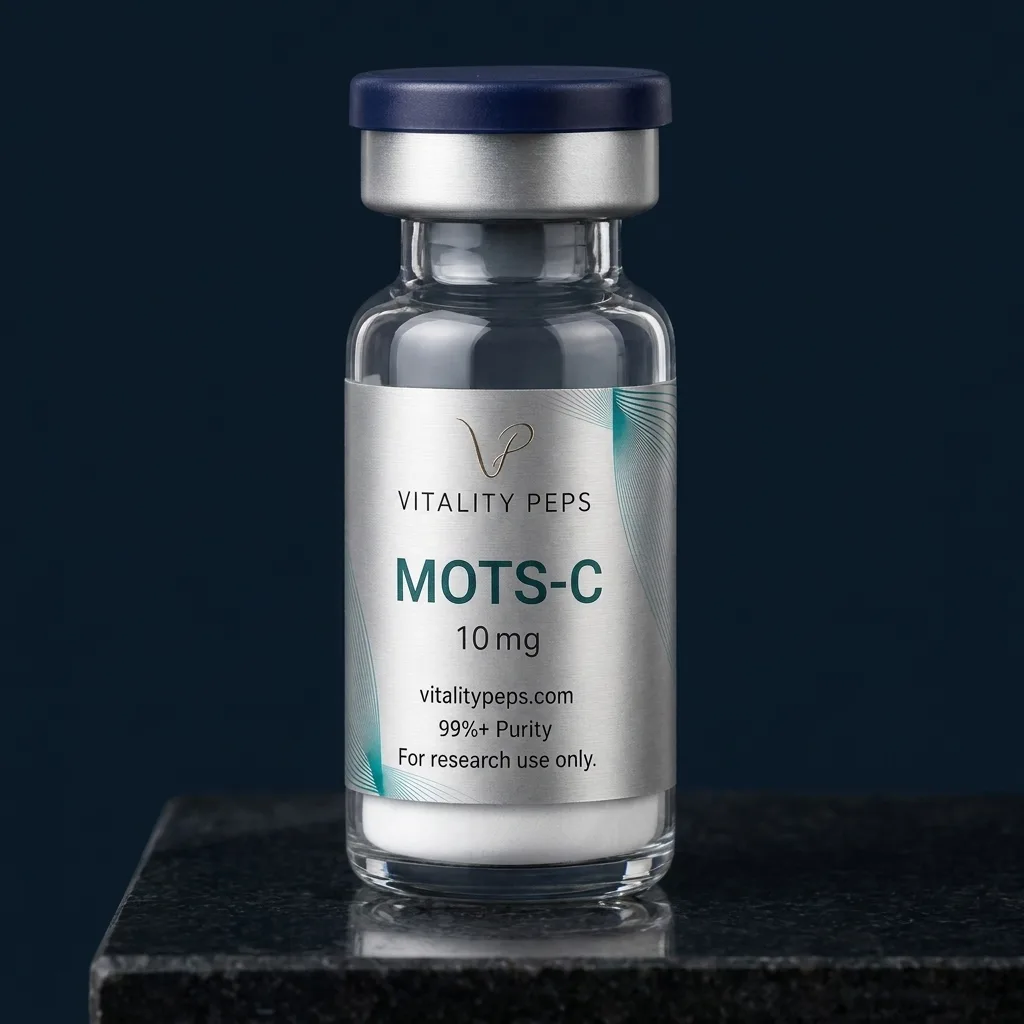
MOTS-C 40mg vial
MOTS-C is a 40mg lyophilized vial research peptide with 99.423% purity by HPLC (batch MO40-0115), supplied with a batch-matched COA, dispatched from the EU within 24 hours on working days.
Limited-time price
- Content
- 40mg
- Purity
- 99.423%
- COA for this batch
- Included
Batch MO40-0115, tested 26 Jan 2026, 99.423% purity
- Shipping from €10
- Tracked and express delivery are available at checkout
- Free shipping on orders over €200
- Dispatched within 24 hours on working days
- Delivery in 1 to 4 working days across the EU and Monaco
- Discreet packaging: plain outer box, no product names or branding on the outside. A neutral billing name on your card statement, no product names.
Add €200 more for free shipping
Free Reship Guarantee
If your parcel is not delivered in 10 working days, or is lost or stopped in transit, we reship it once, free.
- iDEAL
- Bancontact
- Apple Pay
- Google Pay
- Visa
- Mastercard
- American Express
- Crypto
Secure checkout with iDEAL, Bancontact, Apple Pay, Google Pay, Visa, Mastercard, American Express and crypto
What is MOTS-C?
Mitochondrial-derived peptide studied in metabolic-regulation research.
MOTS-c is a mitochondrial-derived peptide encoded within the mitochondrial genome, studied as a regulator of cellular metabolism. It is investigated in the context of AMPK-pathway activation, glucose utilisation and metabolic homeostasis in cellular and preclinical models. Researchers examine MOTS-c for its role in mitochondrial-to-nuclear signalling, insulin-sensitivity pathways and the cellular response to metabolic stress. Its mitochondrial origin makes it a reference compound in studies of exercise mimetics, longevity and energy metabolism. Third-party tested to 99%+ purity and supplied as a lyophilized powder for laboratory reconstitution. For research purposes only, not for human consumption.
Specifications
- Purity
- 99.423%
- Physical Form
- Lyophilized powder
- Vial Size
- 40mg
- Storage
- -20°C
- Recommended Solvent
- Bacteriostatic water (0.9% benzyl alcohol)
- Reconstitution
- Add the solvent slowly along the inside wall of the vial and swirl gently; do not shake.
- Appearance
- White to off-white lyophilized powder
- Shelf Life
- 24 months unopened at -20°C
What does the COA for this batch show?
MOTS-C
99.423% pureMeasured 49.55 mg vs labelled 40mg.
- Compound tested
- MOTS-C
- Label
- 40mg
- Measured mass
- 49.55 mg
- Purity
- 99.423%
- Batch
- MO40-0115
- Test date
- 26 January 2026
Independent third-party analysis of the batch listed above. For research purposes only.
What is MOTS-C studied for?
Studied in the context of
- MOTS-c is a mitochondrial-derived peptide encoded within the mitochondrial genome, studied as a regulator of cellular metabolism.
- It is investigated in the context of AMPK-pathway activation, glucose utilisation and metabolic homeostasis in cellular and preclinical models.
- Researchers examine MOTS-c for its role in mitochondrial-to-nuclear signalling, insulin-sensitivity pathways and the cellular response to metabolic stress.
- Its mitochondrial origin makes it a reference compound in studies of exercise mimetics, longevity and energy metabolism.
How is MOTS-C stored and handled?
Storage
Store lyophilized vials at -20°C, protected from light. Once reconstituted, refrigerate at 2-8°C and use within the recommended window.
Reconstitution
Use bacteriostatic water; add slowly down the inside wall of the vial. Swirl to dissolve, never shake. See the in-house peptide calculator for concentration (mg/ml) and syringe units (IU on a U-100 syringe).
For research use only
Not for human or veterinary consumption. Handle in accordance with your institution's laboratory safety protocols.
For research purposes only. Not for human consumption.
Reviews
No reviews yet.
Reviews cover packaging, delivery and documentation. Products are for laboratory research only; reviews contain no health or use claims.
Checkout is encrypted. Pay by iDEAL, Bancontact, Apple Pay, Google Pay, Visa, Mastercard, American Express and crypto.
- iDEAL
- Bancontact
- Apple Pay
- Google Pay
- Visa
- Mastercard
- American Express
- Crypto
Before you order


Read before you order
All research guides- What is MOTS-c? The mitochondrial-encoded peptide in published researchMOTS-c is a 16 amino acid peptide encoded by a short open reading frame in the mitochondrial 12S rRNA gene, first described in 2015. In mice it was linked to skeletal muscle, where it inhibited the folate cycle and activated AMPK, and under metabolic stress it moved into the nucleus and influenced gene expression. Mouse studies observed changes in insulin sensitivity, diet-induced weight gain, physical performance in old animals and muscle loss after immobilisation. In humans, MOTS-c has been measured in plasma and rose with exercise, but no controlled human trials of the peptide have been published. Vitality Peps supplies MOTS-c for in vitro laboratory research only.8 min read
- SS-31 vs MOTS-c: two mitochondrial peptides comparedSS-31 (elamipretide) is a synthetic tetrapeptide that binds cardiolipin in the inner mitochondrial membrane and was reported to protect the structure and electron transport of mitochondria. MOTS-c is a natural 16 amino acid peptide encoded in the mitochondrial 12S rRNA gene that was described as acting through the folate cycle, AMPK and nuclear gene expression. SS-31 has been tested in randomised human trials with mixed results, including a negative phase 3 trial and positive Barth syndrome studies. MOTS-c evidence comes mainly from mice and from human observational data. No published study has examined them together. Both are supplied by Vitality Peps for in vitro research only.10 min read
- What is SS-31 (elamipretide)? The cardiolipin-binding peptide in researchSS-31 (elamipretide) is a synthetic tetrapeptide, D-Arg-Dmt-Lys-Phe-NH2, that concentrates in the inner mitochondrial membrane and binds cardiolipin. By binding cardiolipin it was reported to keep cytochrome c working as an electron carrier rather than a peroxidase. Animal studies observed effects in models of lung fibrosis, inflammation-related memory impairment and anaesthesia injury. In humans, the phase 3 MMPOWER-3 trial in primary mitochondrial myopathy did not meet its primary endpoints, while studies in Barth syndrome reported improvements, and a 2026 review described accelerated approval in the United States for that condition. Vitality Peps supplies SS-31 for in vitro laboratory research only.8 min read
- How to Store and Handle Research PeptidesLyophilised research peptides are stored in the refrigerator at 2 to 8 °C, or frozen at -20 °C for longer storage, sealed and protected from light. After reconstitution with [bacteriostatic water](/product/bacteriostatic-water-10ml) the solution is kept refrigerated, never shaken, and never refrozen.5 min read
- What your vial should look likeA sealed research peptide vial normally holds a white to off-white lyophilized cake or powder under an intact stopper and crimp cap. Pre-filled pens and nasal spray kits arrive sealed, with their documented appearance on the product page. Appearance never proves identity or purity; the COA for the batch does.4 min read
References and further reading
Published literature about this compound, listed for context only. Nothing here describes a use in humans.
- 1.The mitochondrial-derived peptide MOTS-c promotes metabolic homeostasis and reduces obesity and insulin resistance (Cell Metab, 2015) (pubmed.ncbi.nlm.nih.gov)
- 2.The mitochondrial-encoded peptide MOTS-c translocates to the nucleus to regulate nuclear gene expression in response to metabolic stress (Cell Metab, 2018) (pubmed.ncbi.nlm.nih.gov)
- 3.MOTS-c is an exercise-induced mitochondrial-encoded regulator of age-dependent physical decline and muscle homeostasis (Nat Commun, 2021) (pubmed.ncbi.nlm.nih.gov)
- 4.Mitochondrial-derived microprotein MOTS-c attenuates immobilization-induced skeletal muscle atrophy by suppressing lipid infiltration (2024) (pubmed.ncbi.nlm.nih.gov)
- 5.The mitochondrial-derived peptide MOTS-c relieves hyperglycemia and insulin resistance in gestational diabetes mellitus (2022) (pubmed.ncbi.nlm.nih.gov)
- 6.Plasma MOTS-c levels are associated with insulin sensitivity in lean but not in obese individuals (J Investig Med, 2018) (pubmed.ncbi.nlm.nih.gov)
1× MOTS-C
€114.95